Choosing among the Best Push-Back Storage Rack Suppliers in China starts with the operation, not the catalog. Push-Back Storage can increase pallet density while keeping access to multiple product lanes. It suits facilities that handle several pallets of each SKU and need fast replenishment. It may be less suitable for operations requiring direct access to every pallet.
As an illustrative expert voice, warehouse systems specialist Lin Wei puts it this way: “A rack system earns its place when its storage density still supports safe, predictable handling.” Treat that as a design principle, not a verified quotation from a published source. In practice, ask suppliers how their design handles pallet dimensions, load ratings, forklift clearances, and daily movement patterns. Request drawings that show the actual rack layout. Ask how rails, carts, and frames are inspected and maintained.
Details matter. A few centimeters can affect clearances. A poorly matched pallet can interrupt smooth loading. Compare suppliers on engineering documentation, manufacturing consistency, installation support, spare parts, and communication after delivery. Ask for references from projects with similar loads and operating conditions. Confirm which specifications apply to your site, rather than relying on broad claims.
This guide introduces Chinese suppliers and practical points for comparing them. Supplier names alone do not establish quality. Verify capabilities, documentation, and project fit before making a decision. A useful rack system should make storage more compact without making everyday work harder.
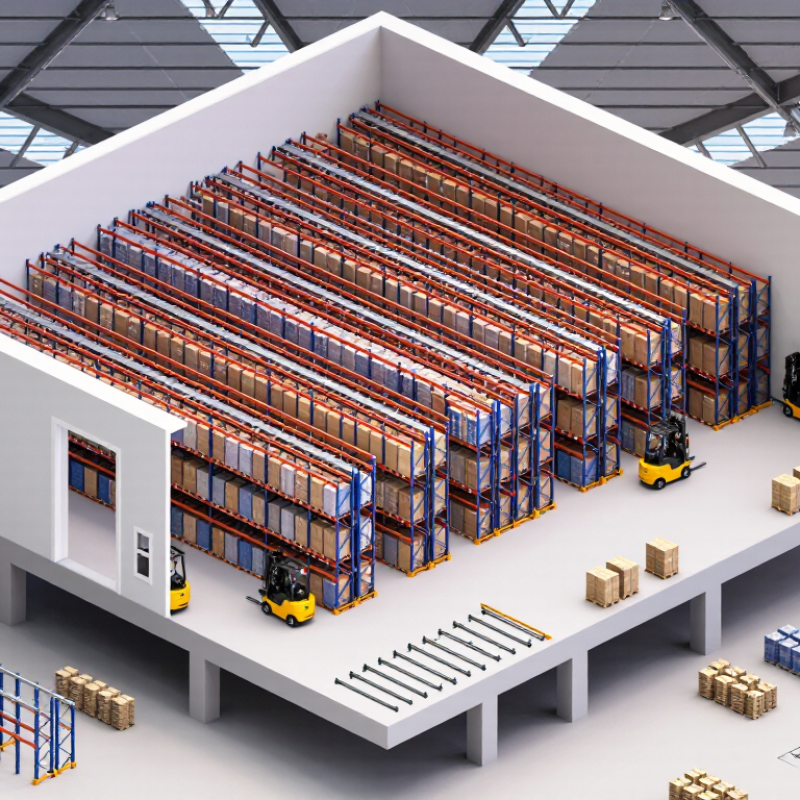
Push-back racking stores pallets two to six deep in inclined lanes with nested carts on rails. Loading a new pallet pushes earlier pallets backward. When operators remove the front pallet, the next pallet rolls forward. Loading and retrieval use the same aisle face, so the system follows last-in, first-out (LIFO). It suits repeat SKUs with steady turnover, but is less suitable for date-sensitive goods requiring strict rotation. Lane depth matters. In a six-pallet lane, rear pallets may wait longer, and a misplaced load can complicate access.
For layout planning, check pallet dimensions, load weights, forklift approach, and required clearances against engineered drawings. Ask suppliers for documented load ratings, installation checks, and a lane demonstration using your actual pallet type. MHI’s 2024 Annual Industry Report reported that 55% of surveyed supply-chain professionals planned to increase technology investment. That figure is not a rack-performance measure, but it reflects ongoing pressure to improve facility productivity. Density alone is not proof of a good layout. Measure travel paths and confirm operators can load and retrieve pallets smoothly; this step is easy to underestimate.
| Evaluation Dimension | Typical Push-Back Rack Information | Buyer Check |
|---|---|---|
| Storage principle | Last-in, first-out (LIFO): pallets are loaded and retrieved from the same aisle, so the most recently stored pallet is normally retrieved first. | Confirm that the inventory rotation method is suitable for the products being stored. |
| Lane depth | Common configurations range from 2 to 6 pallets deep per lane. Deeper lanes generally increase storage density but reduce direct access to individual pallets. | Select depth based on SKU count, pallet quantity per SKU, and required access frequency. |
| Loading operation | A forklift places a pallet on a wheeled or guided carriage and pushes it backward along inclined rails, moving previously stored pallets deeper into the lane. | Check forklift approach, load positioning, carriage guidance, and operator training requirements. |
| Unloading operation | When the front pallet is removed, the remaining pallets move forward under gravity on the inclined track. The system must be designed for controlled movement. | Ask about movement control, end stops, track design, and safe operating procedures. |
| Suitable inventory profile | Often suitable for multiple pallets of the same SKU, batch storage, and operations where high selectivity for every pallet is not essential. | Compare the number of lanes required with the number of SKUs and expected stock levels. |
| Pallet and load compatibility | Pallet dimensions, condition, bottom-board arrangement, and unit-load weight affect carriage support and track design. Compatibility must be verified for the actual load. | Provide pallet drawings, maximum loaded weight, and load details for engineering review. |
| Design and safety review | Rack layout and structural design depend on site conditions, seismic requirements, floor capacity, equipment, and local regulations; a project-specific engineering assessment is necessary. | Request drawings, rated load information, installation requirements, inspection guidance, and applicable compliance documentation. |
| Supplier comparison | Compare suppliers using project-specific engineering, component specifications, quality documentation, installation support, spare-parts availability, and warranty terms. | Evaluate quotations against the same layout, load data, scope, and service requirements. |
Note: The information above describes general system characteristics. Final capacity, dimensions, and configuration must be verified by a qualified rack engineer for the specific site and application.
It stores pallets two to six deep on wheeled carts inside inclined lanes. Each lane opens to one aisle.
A forklift places a pallet and gently pushes it backward. When the front pallet is removed, the next cart rolls forward. It matters.
Loading and retrieval happen from the same aisle face. The last pallet loaded is usually the first one available for removal.
They work well for several pallets of the same SKU with steady turnover. They may not suit goods needing strict date-based rotation.
Match depth to pallet counts per SKU and replenishment patterns. Deeper lanes save space, but older pallets may wait longer.
Share pallet width, length, loaded height, and maximum weight. Include overhang and unstable loads. Small details matter.
Request load calculations, component details, installation guidance, and inspection records. Review forklift turning space and aisle clearances, too.
They can reduce deep lane entry and repeated repositioning, but forklifts still serve the aisle. A trial can show actual movement.
Use your actual pallets to check rolling, wheel noise, and forklift approach angles. Measure retrieval times and aisle entries.
Not always. I once assumed a standard pallet would fit, but uneven overhang changed the clearance needed. Daily handling deserves another look.
Push-Back Storage is a high-density solution that stores pallets in lanes typically two to six pallets deep and follows a last-in, first-out (LIFO) flow. When a forklift places a pallet, it moves nested carts or platforms toward the back of the lane; during retrieval, the next pallet rolls forward by gravity. This arrangement can reduce forklift travel inside the rack and help limit aisle congestion while making better use of available floor space.
Choosing a supplier in China involves more than comparing prices. Evaluate engineering capability, service support, documented load ratings, seismic design provisions, and compliance with EN 15512 where applicable. The right system depends on the operation’s SKU mix, pallet dimensions and condition, required lane depth, throughput, and handling equipment. Confirming these details with suppliers helps ensure the rack layout fits daily workflows, supports safe loading, and can adapt to changing storage needs.

 Hui Lian